
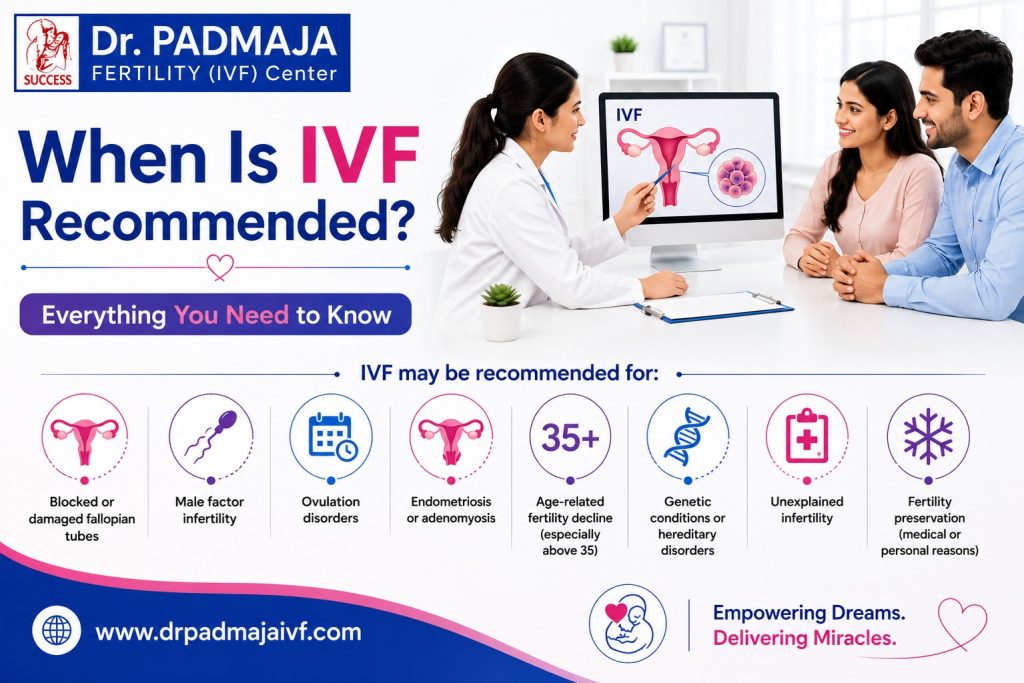
For couples who want to establish a family, infertility can be a challenging and painful process. Thankfully, many people can now become parents thanks to advances in reproductive health and In Vitro Fertilization (IVF). “When is IVF recommended?” is one of the most often asked questions among couples.
IVF is one of the most effective fertility treatments available today, but it is not always the first option. Fertility specialists carefully evaluate a couple’s medical history, age, and fertility condition before recommending IVF. Couples can make educated decisions regarding their reproductive health by knowing when IVF might be required.
What Is IVF?
In Vitro Fertilization (IVF) is an assisted reproductive technology in which eggs are retrieved from a woman’s ovaries and fertilized with sperm in a specialized laboratory. In order to achieve pregnancy, the resultant embryo is subsequently placed inside the uterus.
Over the years, IVF has helped millions of couples worldwide overcome fertility challenges and realize their dream of becoming parents.
When Is IVF Recommended?
1. Blocked or Damaged Fallopian Tubes
The fallopian tubes are essential for natural conception because they allow the egg and sperm to meet. If one or both tubes are blocked or severely damaged, fertilization may not occur naturally.
In such cases, IVF is often recommended because it bypasses the fallopian tubes by fertilizing the egg outside the body.
2. Male Infertility Issues
Male infertility can significantly affect a couple’s ability to conceive. Common causes include:
Low sperm count
Poor sperm motility
Abnormal sperm shape
Problems with sperm production
IVF, often combined with ICSI (Intracytoplasmic Sperm Injection), can improve the chances of successful fertilization and pregnancy.
3. Ovulation Disorders
Women who experience irregular ovulation or conditions such as Polycystic Ovary Syndrome (PCOS) may have difficulty conceiving naturally.
While medications are often used as an initial treatment, IVF may be recommended when other fertility treatments do not produce the desired results.
4. Endometriosis
Endometriosis occurs when tissue similar to the uterine lining grows outside the uterus, affecting fertility and reproductive health.
Women with moderate to severe endometriosis may benefit from IVF, especially when other treatment options have been unsuccessful.
5. Unexplained Infertility
Sometimes fertility tests show normal results, yet pregnancy does not occur. It’s called “inexplained infertility.”
If medications and procedures such as IUI have not resulted in pregnancy, IVF may offer a higher chance of success.
6. Advanced Maternal Age
Female fertility naturally declines with age, particularly after 35 years. Conception becomes more difficult when egg quality and quantity decline with time.
For women in their late 30s or 40s, IVF may provide a more effective path to pregnancy and improve the chances of conception within a shorter timeframe.
7. Repeated Failure of Other Fertility Treatments
Many couples try fertility medications or IUI before considering IVF. If these treatments fail after several attempts, IVF may be the next recommended step.
The controlled nature of IVF allows fertility specialists to closely monitor embryo development and optimize treatment outcomes.
8. Genetic Concerns
Couples with a history of inherited genetic conditions may choose IVF along with genetic testing of embryos before transfer.
This approach can help reduce the risk of passing certain genetic disorders to the child.
9. Fertility Preservation
IVF is also used for fertility preservation. Eggs or embryos can be preserved for later use by women who want to postpone getting pregnant or by those undergoing medical procedures that could harm fertility.
How Doctors Determine the Need for IVF
Before recommending IVF, fertility specialists perform a thorough evaluation that may include:
Hormone testing
Ultrasound examinations
Ovarian reserve assessment
Semen analysis
Fallopian tube evaluation
Medical history review
Based on these findings, a personalized treatment plan is developed to improve the chances of conception.
Benefits of IVF
Higher Success Rates
IVF often offers higher pregnancy success rates compared to many other fertility treatments, particularly for couples facing complex fertility challenges.
Advanced Reproductive Technology
Modern IVF treatments can be combined with techniques such as ICSI, embryo freezing, laser-assisted hatching, and genetic testing to enhance outcomes.
Personalized Care
The success of treatment can be maximized by customizing each IVF cycle to the patient’s unique requirements.
Hope for Complex Fertility Conditions
For couples with infertility problems who might not react to more straightforward treatment options, IVF offers a solution.
Choosing the Right Fertility Center
The success of IVF depends on several factors, including the expertise of the fertility specialist and the quality of care provided by the fertility center.
Couples searching for the best IVF center in Hyderabad should look for experienced specialists, advanced fertility technologies, transparent treatment processes, and personalized patient care.
Dr Padmaja IVF Center is recognized for offering comprehensive fertility treatments designed to address a wide range of infertility challenges. The center assists couples throughout their fertility journey using cutting-edge reproductive methods and a patient-focused approach.
Similarly, DrPadmaja Fertility Center provides advanced fertility solutions, including IVF, ICSI, fertility preservation, and specialized reproductive treatments aimed at helping couples achieve successful pregnancies.
Conclusion
IVF is recommended for various fertility challenges, including blocked fallopian tubes, male infertility, ovulation disorders, endometriosis, unexplained infertility, advanced maternal age, and repeated treatment failures. While IVF may not be the first treatment option for every couple, it often provides the highest chance of success when other methods have not worked.
If you have been struggling to conceive, consulting a fertility specialist can help determine whether IVF is the right choice for your situation. With expert guidance and advanced fertility care, many couples can take a confident step toward achieving their dream of parenthood.
About the Author

This blog is penned by a devoted content specialist passionate about raising awareness around fertility treatments and emotional well- being. With in- depth disquisition on motifs like IVF and fertility, the thing is to give precious perceptivity for couples on their trip to parenthood.
Frequently Asked Questions (FAQs)
1.What is IVF and how does it work?
IVF (In Vitro Fertilization) is a fertility treatment where eggs are retrieved from the ovaries, fertilized with sperm in a laboratory, and the resulting embryo is transferred into the uterus to achieve pregnancy.
2.When do doctors usually recommend IVF?
Doctors may recommend IVF for couples facing infertility due to blocked fallopian tubes, male infertility, ovulation disorders, endometriosis, unexplained infertility, or repeated failure of other fertility treatments.
3.Is IVF the first treatment option for infertility?
Not always. Fertility specialists often begin with less invasive treatments such as fertility medications or IUI before recommending IVF, depending on the underlying cause of infertility.
4.What age is best for IVF treatment?
IVF can be performed at various ages, but success rates are generally higher for women under 35. However, many women in their late 30s and early 40s also achieve successful pregnancies through IVF.
5.Can IVF help with male infertility?
Yes. IVF, especially when combined with ICSI (Intracytoplasmic Sperm Injection), can help overcome male infertility issues such as low sperm count, poor sperm motility, or abnormal sperm morphology.